


Today’s market is full of offers from website developers. Different prices, different companies, but the descriptions all look alike: ten years of experience, hundreds of completed projects, a team of professionals… How do you choose a website developer so that you invest your money wisely and get a decent result? Every business owner who is starting to grow online needs to know this.
Why you need a professional
The internet is full of information about building a website yourself for free using website builders. But such a product is unlikely to be effective or deliver the results you are counting on. Website development actually involves many processes and tasks, from choosing hosting to writing code. You also need to deploy the website to a server, design the main pages and implement the features. This is the minimum a project needs to work properly.
Without specialized knowledge and a few free months to work on it, you cannot handle these tasks on your own. The sensible solution is to turn to a specialist. But this raises another challenge: how do you choose the right website developer? Many important factors depend on this choice:
- Website reliability;
- Technical support for the website;
- Stability of the CMS;
- Its design, navigation and user-friendliness;
- The overall quality of the work;
- How well the website owner’s requirements are taken into account.
Naturally, this affects the success of the whole project. That is why choosing a good contractor is a top priority. Below, we explain where to find a reliable professional.
Freelancer or agency?
Choosing a contractor starts with this question. You can find a professional website developer among freelancers, but in this case the business owner takes a fairly serious risk. The main advantages of a freelancer:
- Low price;
- Direct contact with the person who actually works on the website.
At the same time, this kind of arrangement also has drawbacks:
- No guarantee that the order will be completed;
- It is almost impossible to get your money back if the work is not done or is done poorly;
- A freelancer can simply disappear from your life at any moment;
- You have to organize the whole working process yourself.
And if only one person works on the project, they combine several professions, from programmer to designer. This often leads to a lack of expertise in each area and, as a result, low quality of the final work.
Besides freelancers, website development in Ukraine is done by web studios or digital agencies that cover the whole process. These are professional companies that build websites. Working with them is more reliable. The main advantages:
- A team in which each person is responsible for their own part of the process;
- The ability to monitor all the tasks currently in progress;
- A wider range of services;
- An official contract that sets out the obligations of both parties.
The main drawback of hiring such a company is the high price. But a well-built website will, in the end, quickly bring you a profit that covers the investment.
How to choose a website developer step by step
Take the choice of a contractor seriously, and you will be rewarded with an excellent result. Finding a company takes literally a few days.
Step 1. Define the project goals
A new website is always created to make a profit. To achieve this goal, it solves a number of tasks. Define them so that you can explain the features you need to the developer and judge whether they can handle such an order. To work out your main business requirements, answer these questions:
- Who is your target audience? You need a detailed description: gender, age, social status, hobbies, occupation, interests and so on.
- In which region do you plan to operate?
- What will the website be used for? Selling products, promoting services, researching demand, building brand awareness and so on.
- When do you plan to launch the website?
- Do you anticipate any project challenges or unusual technical requirements?
- Roughly how much do you expect to spend to develop the website and fill it with content?
- What content will be published, and who is responsible for the content?
- Do you need user registration on the website? What features will be available in the user account?
- Do you need integration with a CRM system or inventory management software?
- Do you need accounting or bookkeeping features, telephony integration and other functions?
- What do you plan to add to the website in the future?
- How do you plan to promote the website after launch?
Any website built from scratch starts with a questionnaire like this. Why is it needed? First, you yourself will better understand the scope and specific goals of the project. Second, the developer will be able to offer you implementation options faster and more accurately. Any good web agency will ask you to fill out such a questionnaire. It may also include other questions. Take the time to answer them, because this helps you save money: only the necessary, effective features will be developed. The developers will also be able to lay the “foundation” for future improvements, which helps avoid unnecessary costs in time and money.
An important point: think about ongoing support for the website in advance. Simply launching a website is not enough to do business online. Your niche most likely already has its leaders, and your competitors may be winning customers over with convenient navigation, up-to-date information and good rankings. For your website to become like that, it needs to be regularly improved, checked for errors that then get fixed, and kept up to date. That is exactly what technical support and maintenance are for.
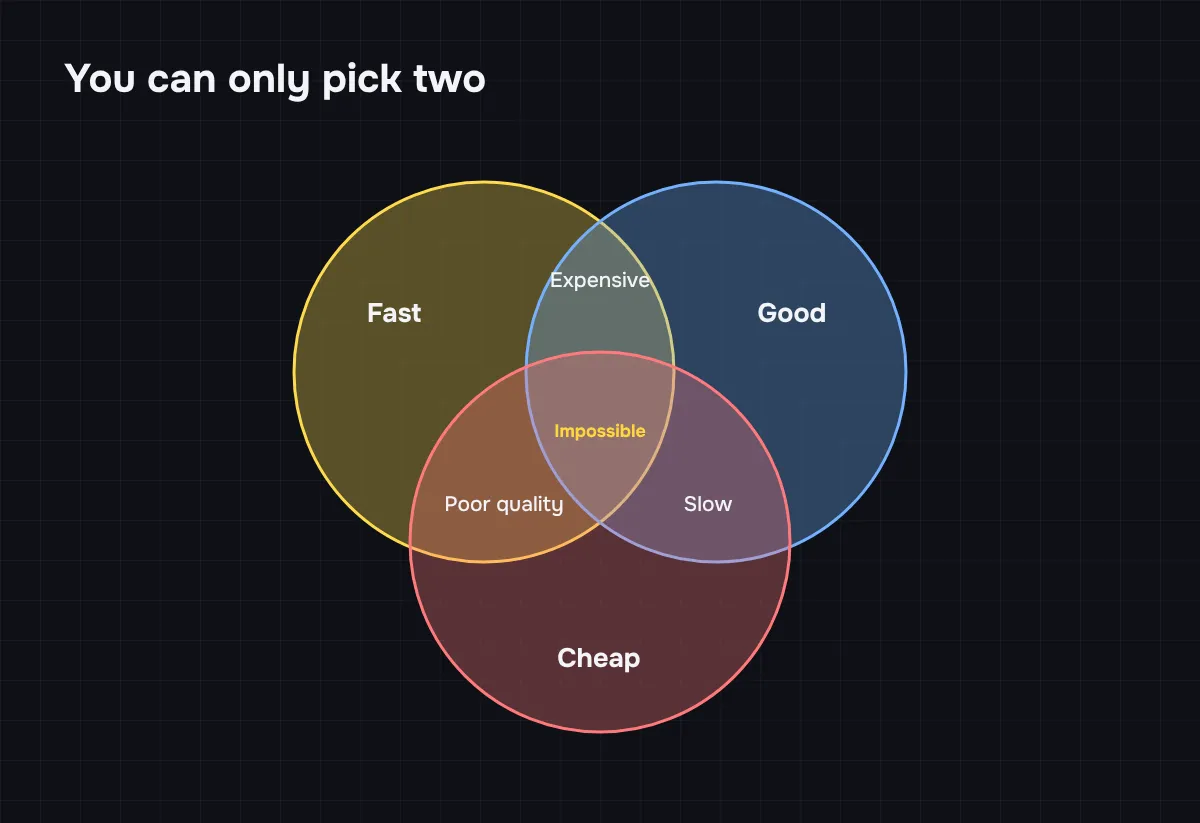
Agencies that cover the whole process can take this on. It is ideal if one company handles both the website development and its further maintenance. The specialists will be 100% “up to speed” and able to complete tasks as quickly as possible. Of course, this costs money, but it is worth it. A high-quality online business cannot be built on the cheap: remember that!
Step 2. Find candidates
Your task is to find 8–10 candidates. Considering your needs (including both development and promotion), rule out the options that cannot cover them. There is also no point in contacting companies that quote a price that is too high for you.
Where to look for a website developer:
- In the footer of competitors’ websites. Find websites you like and try to find information about the developer.
- In a search engine. Just type in your query (“website development services”) and go through the results. On the first two pages, you will definitely find companies that interest you.
- Word of mouth. If people you know have had a website built, ask them. Who did they work with, what did they like and what did they not like?
- In rankings, such as the “IT Rating of Ukraine” and others. They are updated regularly. Pay attention to companies that appear in several lists.
If you have a large company and are planning a large-scale project, such as developing an online store, you can hold a tender and invite different studios you like to take part in it.
Step 3. Evaluate candidates in a comparison table
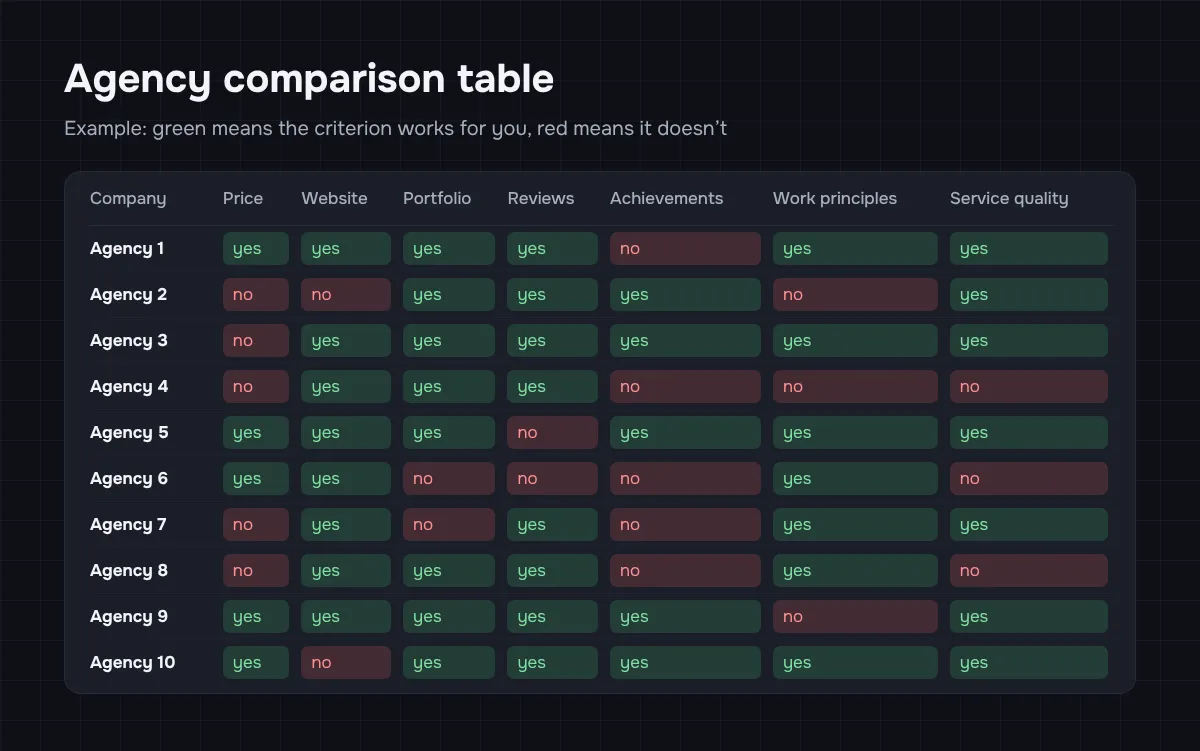
To keep things clear, create a table that shows the key information about each developer. Put the company names in the first column and choose the main criteria you will evaluate.
The company’s own website
A website developer without its own website is a case of “the shoemaker’s children go barefoot.” It is a clear sign of a lack of professionalism. The developer’s website should have convenient navigation, a modern design, properly working features and up-to-date information about the company’s work.
Portfolio
Check the portfolio for work you like and work similar to your project, and look at the rankings and traffic of the websites they built.
Reviews
One of the key indicators, but not always a reliable one. A company is unlikely to post an unflattering review of itself on its own website, so try to find people’s opinions on third-party platforms. If the website links to clients, try to contact them and find out what it was like to work with the company.
Achievements
It is a nice bonus if the company has any awards or a good position in rankings. This is not the main indicator, but it does point to the agency’s professionalism.
Working principles
When you review the information on the website or talk to a manager in person, clarify the following points:
- Transparency of work (whether you can track the progress of tasks);
- Specialists of different profiles on staff, especially if you want the whole website built by one company;
- Warranty service;
- Technical support;
- Payment (which options are available);
- Client approval before each stage of work begins;
- Prompt response to requests;
- The ability to demonstrate the project and test it on a staging copy.
All of these points will help you control the development process and take an active part in it, even remotely. You will be more confident in the contractor and have assurance that the tasks will be completed. These are mandatory conditions for large-scale projects, such as building an online store from scratch.
It is also useful to look at the company’s social media: what content do they publish, and what style of communication with clients do they choose? Pay attention to the materials they publish on their blog. If the agency’s positioning does not appeal to you, you are unlikely to work well together.
Quality of service
You can assess this criterion when you get in touch with a company manager. Leave a callback request on the website and see how quickly they call you back. During the conversation, explain exactly what you need and which features. This gives the consultant the chance to give you a price range. At this stage, they will not be able to tell you the exact cost of website development. It will only be known after the technical specification is written. Enter the approximate amount in the table. Also pay attention to the contractor’s competence. Do they ask clarifying questions, and can they answer yours accurately and clearly?
As you evaluate each criterion, put “+” and “-” or “yes” and “no” in the table next to each company. This way, you will immediately filter out the options that do not suit you.
Step 4. Choose a contractor
Look at your table. The contractor that has received the most positive marks from you is the right agency. A company with the best balance of price and pluses will also do. For example, in our table “Agency 3” collected the most pluses, but its prices are steep. On the other hand, “Agency 1” has an excellent price and lacks only achievements, which is not the most important criterion.
It is worth saving the contacts of other good companies as a backup. If something about working with the chosen agency does not suit you, you can always turn to another one without doing all of this work again.
Signing the contract
Once you have chosen the company you want to work with, visit its office and meet the head of the company. This not only puts a logical end to the process and helps you form your final opinion of the company, but also raises the developer’s sense of responsibility. After all, they simply will have nowhere to run :).
Once you have talked to the team, filled out the brief and received the technical specification, you will be told the exact cost of development. Additional expenses may come up during the work, so always plan a bigger budget than the amount quoted. Once the estimate is approved, a contract is drawn up. This is the key moment, after which all the work begins. Now you only need to monitor the work process and submit your edits and comments. Each stage, such as logo design, website design, feature implementation and so on, will be approved with you. In the end, it is the right choice that determines whether your partnership with a web company works out well.